
AI integration costs: budget for your first production workflow
Estimate implementation, evaluation, human review, and operating costs with a worked budget whose assumptions you can replace.
Budget for an AI integration in two parts: the work needed to build and validate it, and the cost of operating it at the expected volume. Model usage belongs in the second part alongside human review, exception handling, hosting, support, and changes to connected systems. A small API bill can coexist with an expensive manual review queue.
The examples below use fictional workloads and assumed rates to demonstrate the arithmetic. They are not market averages, provider prices, or Counterweight Labs quotes. Replace each input with evidence from your process and the suppliers you are considering before making a purchasing decision.
Define the unit of work
Choose something you can count: a support response drafted, a document classified, or an alert prepared for analyst review. Define what counts as successful completion and what requires another person to intervene. A workflow that returns a syntactically valid answer has not necessarily completed the business task.
Record the current completion time, error rate, review effort, and volume for that unit. NIST's AI Risk Management Framework calls for considering a system's intended use, expected benefits and costs, and oversight. That framing helps keep an integration budget connected to the work the system is supposed to perform.Source: NIST AI RMF Core
Estimate the initial implementation
| Work | Assumed hours | Illustrative cost |
|---|---|---|
| Workflow and data-access mapping | 24 | $3,000 |
| Connectors and application integration | 64 | $8,000 |
| Evaluation cases and failure handling | 48 | $6,000 |
| Rollout, monitoring, and handoff | 24 | $3,000 |
| Total | 160 | $20,000 |
This allocation is an example for discussion, not a promise about project duration. A connector with documented permissions and reliable test data is different from a system that requires manual exports and inconsistent identifiers. Separate known engineering tasks from unresolved dependencies. Investigate expensive unknowns in a small discovery step before treating the estimate as a fixed commitment.
Calculate recurring cost at a stated volume
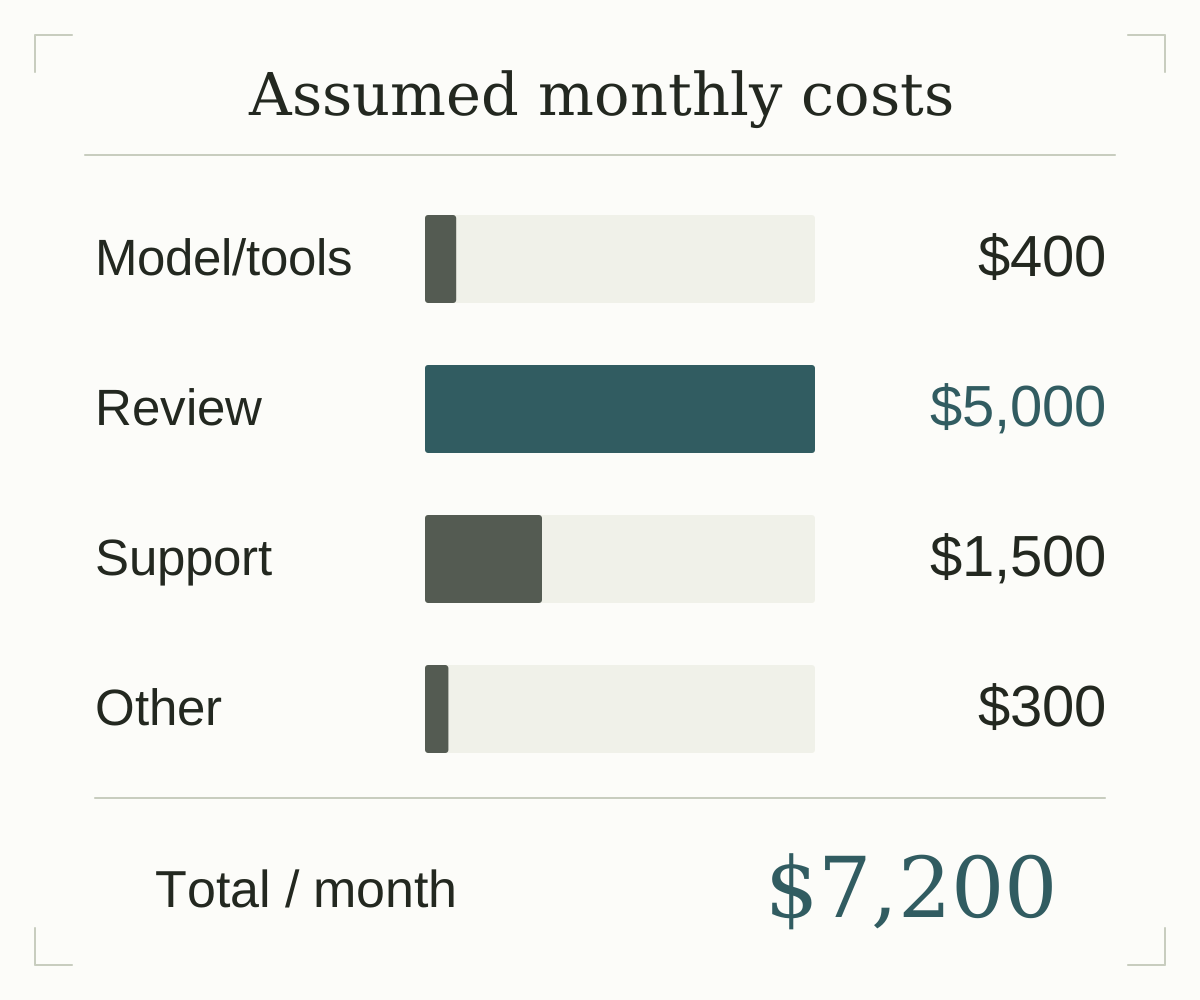
Suppose a fictional workflow handles 10,000 items per month. Assume model and tool usage costs $0.04 per item across all calls. Assume 20% of items require three minutes of human review at a fully loaded $50 per hour. Add 20 hours of monthly support at $75 per hour and $300 for other operating services.
| Component | Calculation | Monthly cost |
|---|---|---|
| Model and tool usage | 10,000 × $0.04 | $400 |
| Human review | 2,000 × 3 minutes ÷ 60 × $50 | $5,000 |
| Support and maintenance | 20 hours × $75 | $1,500 |
| Other operating services | Assumed fixed charge | $300 |
| Total | Excludes setup, tax, and exceptional incidents | $7,200 |
Under these assumptions, the operating cost is $0.72 per item. If the review rate rises to 40% while review time stays the same, the monthly total becomes $12,200. That sensitivity is a reason to measure review demand during a pilot. It does not justify lowering the review rate without evidence that doing so is acceptable.
Compare costs on the same basis
Compare the new workflow with the current process using the same definition of completion. Include corrections, escalations, and quality checks on both sides. Time saved does not automatically become cash savings: employees may use the capacity for other work, and fixed staffing costs can remain. State whether the business case depends on capacity, faster response, improved coverage, or reduced spending.
For variable model pricing, estimate actual input and output sizes, repeated attempts, retrieval, and tool calls from representative cases. Recheck the provider's current pricing and terms when you prepare a quote. Avoid basing a production budget on a single successful demonstration or the smallest prompt your system will process.
Buy a measurable first phase
A useful first engagement produces a working integration, representative evaluation results, and a revised operating estimate. Ask who owns the connectors, evaluation cases, runbooks, and monitoring after handoff. Specify how configuration changes and additional systems affect the scope. Reserve time for the team that will support the workflow to exercise failure handling before rollout.
Bring a sample of recent work, its tools and data sources, the manual effort involved, and the outcomes you consider unacceptable. Those inputs let an implementation team replace broad assumptions with a budget you can evaluate.
Sources
- NIST AI RMF Core airc.nist.gov
Bring one recurring workflow, its systems, and examples of good and bad outcomes. We can map the integration work and build an evaluation-led implementation plan.
Explore ai consulting & integrationContinue reading
AI workflow automation: choose your first use case
Compare recurring tasks by value, data access, failure cost, and review effort before choosing an AI workflow to implement.
Read the guide
AI agent production readiness: a rollout checklist
Review evaluation evidence, permissions, approvals, failure handling, monitoring, and ownership before giving an AI agent real work.
Read the guide