
AI workflow automation: choose your first use case
Compare recurring tasks by value, data access, failure cost, and review effort before choosing an AI workflow to implement.
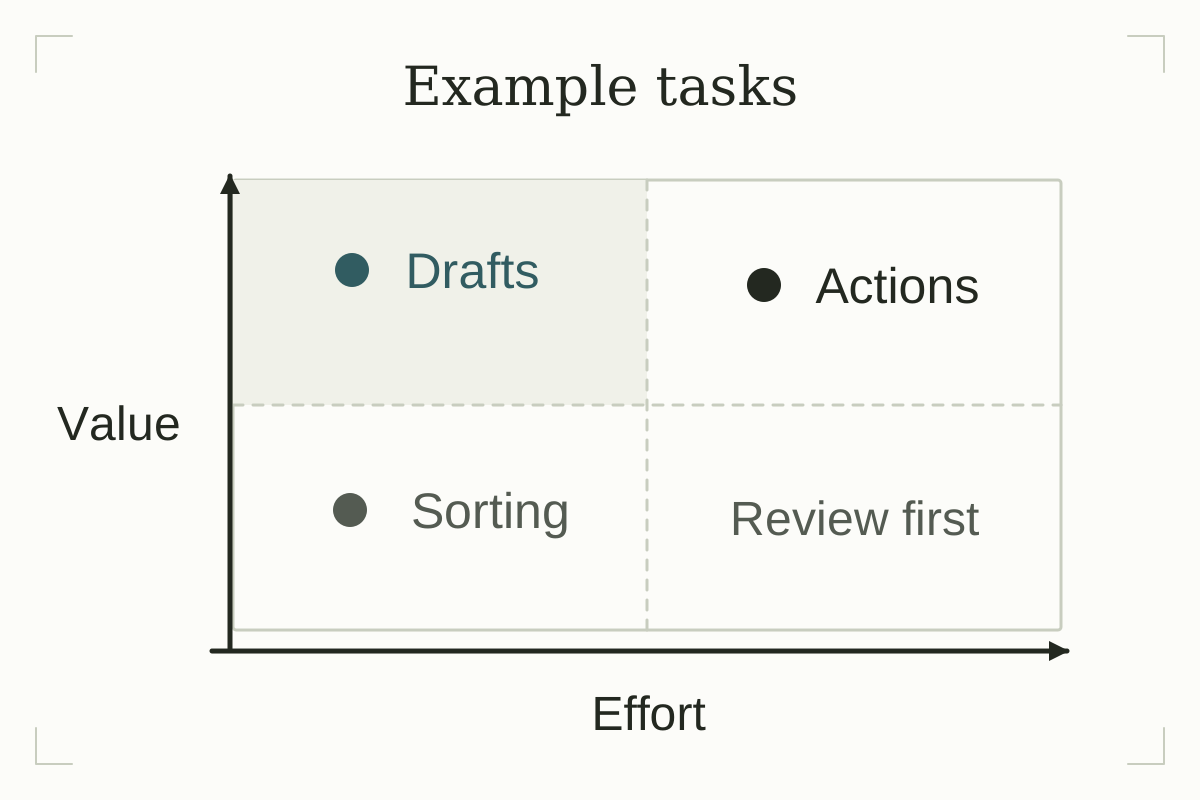
Choose a first AI workflow that repeats often, has a recognizable good outcome, and can fail without creating an uncontrolled business consequence. You need enough real examples to evaluate it and an owner who can decide whether the result is useful. A narrow task with those properties gives you a better basis for learning than a broad request to automate an entire department.
Start by observing the work. Ask the person doing it to show recent examples, the systems they consult, the decisions they make, and the exceptions they handle. Record the points where judgment is required. What looks like copying information between tools may depend on context that is absent from both tools.
Create a short list from real recurring work
Useful candidates might include preparing a support-reply draft, assembling an analyst's investigation context, extracting fields from a document, or routing a ticket for review. Each still needs a defined boundary. A support assistant that drafts an answer has a different consequence profile from one that promises a refund, changes an account, and sends the response automatically.
NIST's AI Risk Management Framework emphasizes understanding intended use, the people affected, and the conditions in which a system will operate. Apply that to the shortlist by writing down who receives the output, what they do with it, and what happens when it is wrong.Source: NIST AI RMF Core
| Candidate | Why it may be useful | Question to resolve first |
|---|---|---|
| Support-response draft | A reviewer receives an answer with relevant source material. | Can the reviewer detect incorrect account details or unsupported promises? |
| Document classification | A repeated task has a small set of defined destinations. | Do ambiguous documents have an acceptable review path? |
| Automatic refund execution | The workflow can complete a customer action. | Are eligibility, limits, identity, and approval independently enforced? |
Assess access and ownership before building
Check whether the workflow can obtain the necessary records through supported interfaces. Identify the data owner, permissions, retention constraints, and test environment. An apparent quick win can become an access-integration project if the inputs exist only in individual inboxes or undocumented exports.
Name the owner of the business outcome as well as the engineer maintaining the integration. The business owner decides what an acceptable result looks like and reviews exceptions. The technical owner handles credentials, changes to APIs, monitoring, and failure recovery. If neither role has time to support the workflow, reduce its scope before starting.
Establish a comparison you can measure
Take a representative sample of recent cases and preserve the context needed to judge them. Include routine work, ambiguous inputs, missing information, and cases the system should decline or escalate. Define the evaluation criteria before looking at the model's output. Keep a held-out set for checking changes so repeated tuning does not only improve the examples the team already knows.
Compare the AI workflow with the current process and any simpler rules or search that might solve the task. Measure total completion time, including review and correction, rather than only generation latency. Record how often the reviewer accepts the result, edits it, rejects it, or must start again. A fast draft can still create more work if verifying it requires repeating the original investigation.
Choose a bounded first release
- One clearly named task, with specified inputs and outputs.
- A limited set of connected systems and permissions.
- Representative evaluation cases and a documented comparison process.
- An explicit review or escalation path for uncertain outcomes.
- A way to stop the integration and continue the manual process.
For example, begin with an assistant that gathers account context and proposes a reply inside the existing support tool. Keep sending and account changes in the established user workflow while you evaluate the draft's usefulness. This makes the first phase easier to assess because you can observe how people use the output without immediately changing every operational responsibility.
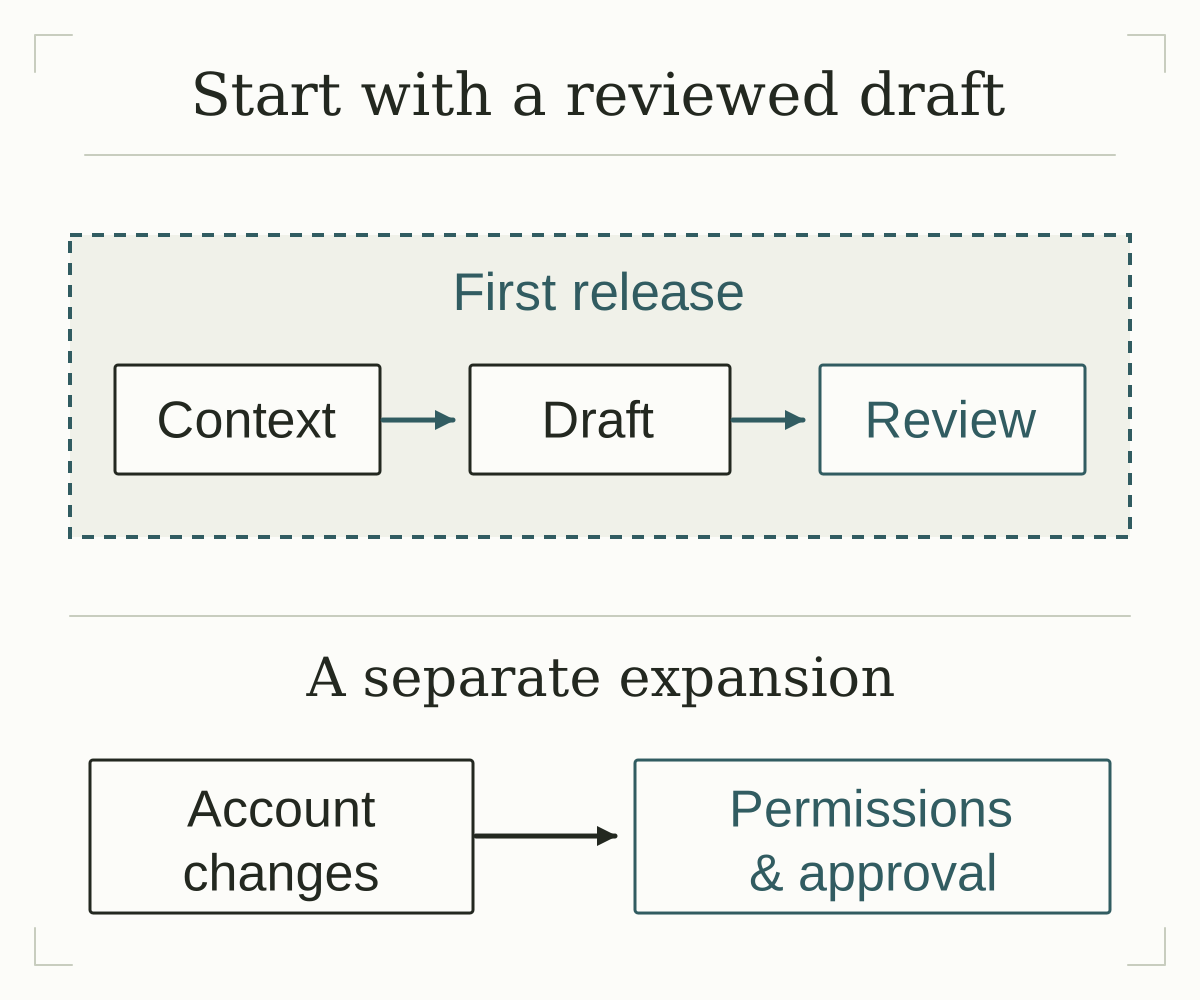
Decide what would justify expansion
Write the conditions for proceeding, revising, or stopping the pilot. These might include acceptable error categories, review effort, completion time, and operating cost at the intended volume. Choose thresholds that reflect the consequence of failure; a document-routing suggestion and a financial action should not share an arbitrary accuracy target.
Review the difficult cases with the people doing the work. If failures concentrate around missing data, improve that dependency before changing models repeatedly. If the workflow is useful only with expensive supervision, include that supervision in the business case. Expand to another task when the first one has an owner, evidence of value, and a support process your team can maintain.
Sources
- NIST AI RMF Core airc.nist.gov
Bring two or three recurring tasks and examples of their inputs and outcomes. We can help select a first integration and define how to measure it.
Explore ai consulting & integrationContinue reading
AI integration costs: budget for your first production workflow
Estimate implementation, evaluation, human review, and operating costs with a worked budget whose assumptions you can replace.
Read the guide
AI agent production readiness: a rollout checklist
Review evaluation evidence, permissions, approvals, failure handling, monitoring, and ownership before giving an AI agent real work.
Read the guide